
When teeth are lost or extracted, the jawbone beneath them begins to shrink. Without the natural pressure of chewing, bone width can decrease by as much as 25% within the first year of tooth loss. That deterioration does more than compromise your oral health — it can alter the contours of your face and make it impossible to place dental implants without additional preparation. At our Tega Cay location, our board-certified surgeons offer a full range of bone grafting procedures to restore the jawbone and set the foundation for lasting implant success.
Bone grafting is a surgical technique that rebuilds areas where bone has been depleted due to tooth loss, periodontal disease, trauma, or a congenital anomaly. Our oral and maxillofacial surgeons — board-certified by the American Board of Oral and Maxillofacial Surgery and members of the American Association of Oral and Maxillofacial Surgeons — bring advanced surgical training and precise, 3D-guided planning to every grafting procedure. If you are considering dental implants and have been told you may not have enough bone, grafting can change that outcome.
What Is a Bone Graft?
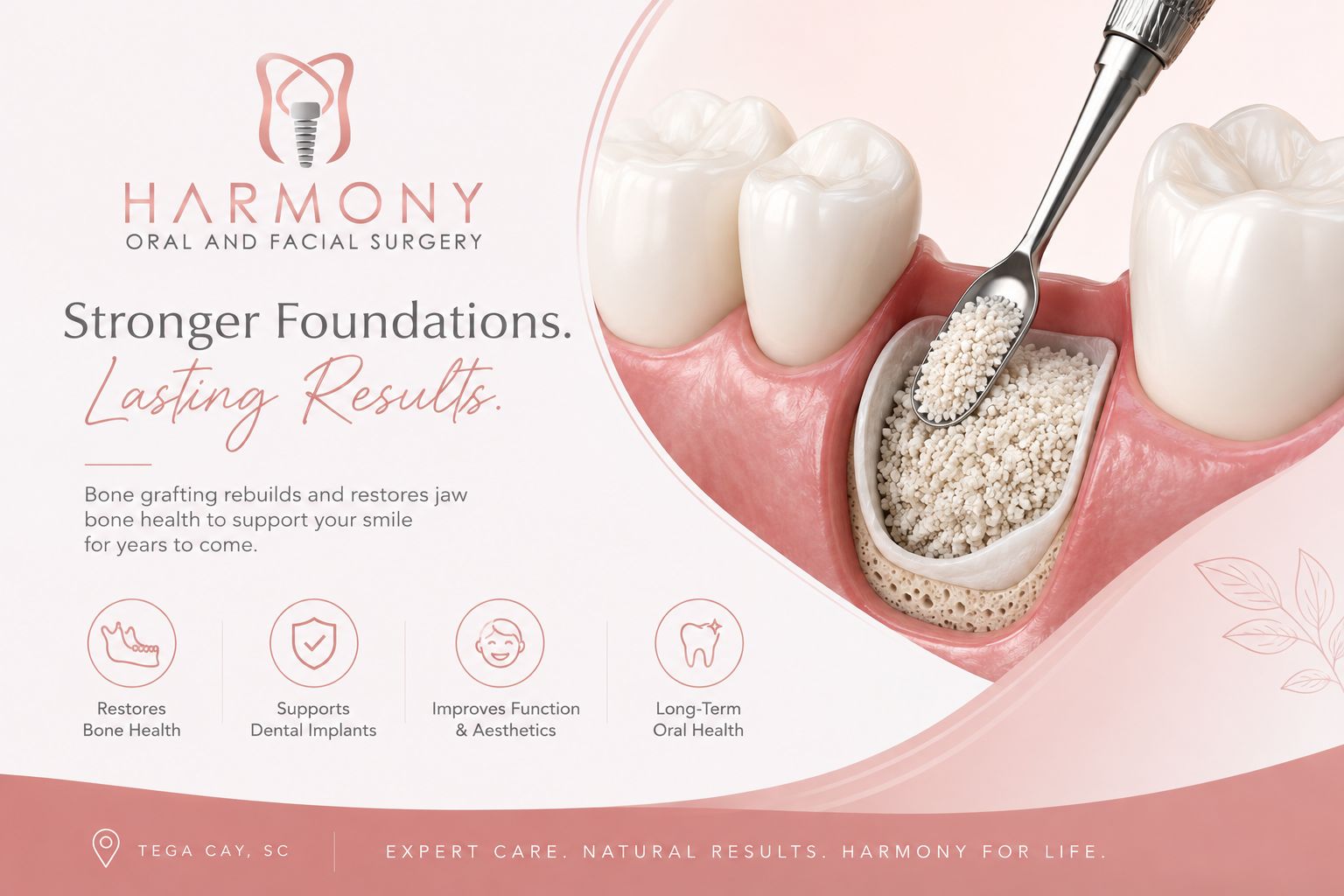
A dental bone graft adds volume and structure to the jaw in areas where bone has been lost. The graft material serves as a scaffold, stimulating the body to generate new, natural bone over time. According to research published in the NIH’s National Library of Medicine, bone grafts have become essential to modern implant dentistry, enabling successful placement even in patients with significant bone deficiency. Once the new bone matures and integrates, a dental implant can be placed with a stable, long-term foundation.
Types of Bone Graft Material
The right graft material depends on the extent of bone loss, the location in the jaw, and each patient’s individual anatomy. Our surgeons evaluate all options and recommend the approach most likely to achieve lasting results.
Your surgeon will discuss which option fits your case, your health history, and your implant treatment plan.
Grafting Procedures We Offer
Different clinical situations call for different grafting approaches. Our surgeons perform the full spectrum of bone grafting procedures, from simple socket preservation to more advanced augmentation techniques.
Socket Preservation
Performed at the time of tooth extraction, socket preservation places graft material directly into the empty socket before it can collapse. This is the most straightforward form of grafting and significantly reduces the bone loss that would otherwise occur in the weeks following extraction. It protects the site for a future implant and does not extend overall recovery time.
Ridge Augmentation
The alveolar ridge is the band of bone that houses your tooth roots. When a tooth has been missing for some time, or when the ridge has narrowed due to denture wear or trauma, ridge augmentation rebuilds its height and width. Graft material is placed into the deficient area, often covered with a specialized membrane to guide tissue regeneration and protect the graft while new bone develops. Once sufficient healing occurs, an implant can be placed into the restored ridge.
Sinus Lift
Patients missing upper back teeth often lack the bone height needed for implants due to proximity to the sinus cavity. A sinus lift procedure gently raises the sinus membrane and places graft material between the jaw and the sinus floor, creating the bone height required for a successful upper-jaw implant. This is a common preparatory step for patients pursuing implants in the posterior maxilla.
Advanced Grafting for Severe Bone Loss
In cases where bone deficiency is extensive — due to long-term tooth loss, prior pathology, or significant facial trauma — more involved grafting techniques may be indicated. This can include block grafting using the patient’s own bone, ridge expansion for horizontal deficiencies, or autogenous grafts paired with membranes and biologically active materials. Our surgeons plan these cases using 3D imaging to ensure precision and predictability.
What to Expect Before and After Your Procedure
Most bone grafting procedures at our Tega Cay office are performed under local anesthesia or IV sedation, depending on the scope of the case and patient preference. Here is what the process typically looks like from start to finish.
Am I a Candidate for Bone Grafting?
You may benefit from bone grafting if any of the following apply to you.
A consultation with our surgical team, which includes a 3D CBCT scan, will confirm whether grafting is needed and which approach is appropriate for your case. Many patients who have been told implants are not possible for them discover that bone grafting opens the door to the restoration they want. You can also learn more about our bone grafting services at our Charlotte office if that location is more convenient for you.